Strategy
Chat engine optimisation: how to get cited by AI assistants
A practical, vendor-neutral guide to chat engine optimisation (GEO/AEO): how AI assistants find and cite sources, a checklist, measurement, and honest caveats.
On this page
People increasingly ask an AI assistant instead of typing a query into a search box. The assistant reads a handful of sources, writes one answer, and names or links a few of them. Chat engine optimisation is the work of making your business one of those sources. It is mostly good technical SEO and clear writing, applied with an understanding of how assistants retrieve information.
This guide explains that retrieval process, gives a practical checklist, shows how to measure progress, and is honest about what nobody can promise.
What is chat engine optimisation?
Chat engine optimisation is the practice of making a website and brand easy for AI assistants to discover, understand, quote and attribute. You will also see it called generative engine optimisation (GEO) or answer engine optimisation (AEO). The terms overlap almost entirely; "chat engine" simply names the interface people now use.
The goal differs slightly from classic SEO. A search result wins a click. An assistant's answer may mention your brand, paraphrase your page and link to it, or do only some of those. Being cited accurately is the outcome to aim for.
How do AI assistants find and cite sources?
Assistants draw on two kinds of knowledge.
Training data. Models learn from large text collections gathered by crawlers before a cut-off date. You cannot edit this after the fact, and it changes only when a new model is trained.
Live retrieval. When a question needs current or specific information, the assistant runs one or more web searches, fetches a few pages, extracts the relevant passages, and writes an answer grounded in them. This is retrieval-augmented generation, the same pattern described in RAG chatbots explained. Citations come from this step, so this is where most of your effort should go.
Three practical consequences follow.
- Search indexes still decide who is eligible. Assistants generally retrieve through a search index, either their own or a partner's. Google's AI features draw on the Google Search index. If a page is not indexed and reasonably ranked for the underlying query, it is unlikely to be retrieved.
- Assistants rewrite questions into several searches. One conversational question can become multiple narrower queries. Pages that answer specific sub-questions clearly have more chances to be picked up.
- Passages are quoted, not pages. The assistant lifts the few sentences that answer the question. A definition buried deep in a long introduction is harder to extract than one stated plainly under a relevant heading.
The practical checklist
1. Serve crawlable, server-rendered HTML
Many AI crawlers fetch raw HTML and do not run JavaScript. If your main content appears only after client-side rendering, some assistants will see an empty page. Use server-side rendering or static generation for anything you want cited, and check by viewing the page source: the text you care about should be there.
2. Decide your robots.txt rules for AI crawlers
AI companies publish the user-agent names of their crawlers, and most separate training from search and user-initiated fetching. Names change, so confirm them in each provider's documentation before relying on this table.
| Provider | Crawler user agents (examples) | Typical purpose |
|---|---|---|
| OpenAI | GPTBot, OAI-SearchBot, ChatGPT-User | Training, search results, user-requested fetches |
| Anthropic | ClaudeBot, Claude-SearchBot, Claude-User | Training, search, user-requested fetches |
| Perplexity | PerplexityBot, Perplexity-User | Search index, user-requested fetches |
| Googlebot; Google-Extended token | Search including AI features; Google-Extended controls Gemini training and grounding, not Search | |
| Microsoft | Bingbot | Bing index, which also feeds Copilot |
The key decision is whether to separate training from search. You can block a training crawler while allowing the search crawler that makes citation possible. A minimal example:
User-agent: OAI-SearchBot
Allow: /

User-agent: GPTBot
Disallow: /

Sitemap: https://www.example.com/sitemap.xml
Also check your CDN or firewall. Bot-protection settings sometimes block AI crawlers by default, which overrides anything robots.txt allows.
3. Publish an accurate sitemap
An XML sitemap with honest last-modified dates helps every crawler find new and updated pages. Reference it from robots.txt and submit it in Google Search Console and Bing Webmaster Tools.
4. Consider llms.txt
llms.txt is a proposed convention: a Markdown file at the root of your site that summarises what the site is about and links to the most useful pages, written for language models rather than people. It is cheap to create and harmless. Treat it as a courtesy, not a lever; see the caveats below.
5. Add structured data
JSON-LD markup for Organization, Article, FAQPage, Product and BreadcrumbList states facts about your pages in an unambiguous form. It feeds the search indexes assistants depend on and reduces the chance of your brand details being misread. Keep it consistent with the visible page.
6. State definitions and direct answers plainly
Open each page or section with the answer in two or three sentences, then elaborate. Write definitions in the form "X is…". Use question-style headings where they match what people ask. A good test: if the paragraph were quoted alone, with no surrounding context, would it still be correct and would it still name your brand?
7. Include FAQ sections
FAQs mirror the way people phrase questions to assistants. Keep each answer self-contained, avoid "as mentioned above", and name the product or company in the answer rather than saying "we".
8. Offer original specifics
Assistants have countless generic pages to choose from. What they lack are specifics only you can provide: exact prices, limits, supported formats, step-by-step procedures, comparison tables, your own data and clearly labelled first-hand experience. Specific pages are more useful to quote and harder to substitute.
9. Name your entity consistently
Use one spelling of your company and product name everywhere: site, social profiles, directories, app listings and press. Assistants assemble their picture of a brand from many sources, and inconsistencies produce vague or wrong descriptions.
10. Show freshness dates
Display published and updated dates on articles and keep them truthful. Put the same dates in your structured data and sitemap. Review important pages on a schedule; for fast-moving topics, assistants tend to favour sources that are visibly current.
11. Be present on third-party sources
Assistants often cite directories, review sites, community forums, industry publications and documentation hubs rather than a vendor's own pages, particularly for "best tool for…" questions. Keep your profiles there accurate and complete, contribute useful answers where your customers ask questions, and never fake reviews or seed spam.
How do you measure chat engine optimisation?
Measurement is less mature than in classic SEO, so combine several imperfect signals.
- Referral traffic from assistants. In your analytics, segment sessions by referrer domains such as chatgpt.com, perplexity.ai, gemini.google.com, copilot.microsoft.com and claude.ai. Not every click passes a referrer, so treat this as a floor, not a total.
- Manual prompt checks. Keep a fixed list of the questions your customers ask. Run them across the main assistants on a regular schedule and record whether you are mentioned, whether you are linked, and whether the description is accurate. Answers vary between runs, so look at trends rather than single results.
- Brand mentions and branded search. Rising branded search demand in Search Console can indicate that people heard of you elsewhere, including from an assistant.
- Search Console and Bing Webmaster Tools. Indexing coverage, queries and impressions still describe your eligibility for retrieval. At the time of writing, Google includes activity from its AI features within overall Search performance totals rather than reporting it as a separate line.
- Server logs. Look for the crawler user agents listed above. If search crawlers never fetch your key pages, fix access before anything else.
Honest caveats
There are no guarantees. Assistants choose sources with systems that are not public, change frequently and produce different answers for the same question. Anyone promising a guaranteed citation or "number one in ChatGPT" is overselling.
llms.txt is not a ranking factor. It is an emerging convention. No major assistant has confirmed using it to choose or rank citations, and Google representatives have said publicly that Google Search does not use it. Publish one if you like, but do not expect it to move results.
The fundamentals carry most of the weight. Crawlable pages, a healthy search presence, clear writing and a consistent reputation across the web matter more than any AI-specific trick.
What happens after the citation?
A citation brings a visitor with a specific question, often mid-decision. If your site then makes them hunt through menus, some of the value is lost.
This is where an on-site assistant fits. Chyt.ai turns the same content you have just made clear and crawlable, such as your website, documents and help pages, into a chatbot that answers visitors' questions on your own site, grounded in that content and with source citations. It does not influence what external assistants say about you. It makes sure that once someone arrives, they get a direct answer, and can be handed to a person or captured as a lead when that is the better outcome.
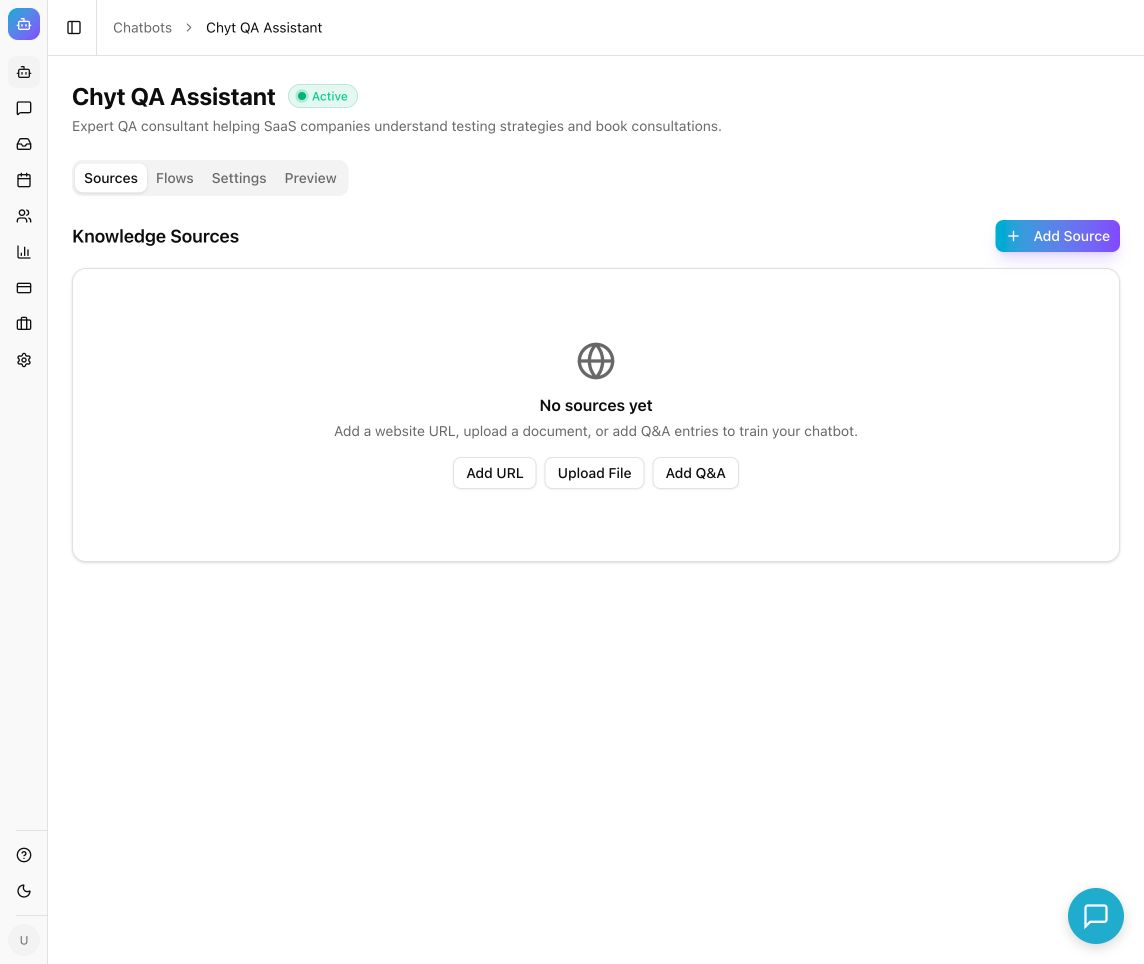
The two efforts reinforce each other: pages written as clear, self-contained answers are easier for external assistants to quote and for your own chatbot to retrieve. The walkthrough on turning your website into an AI chatbot shows the process, and the features overview lists the available knowledge sources and channels.
Next steps
Work through the checklist in order: crawlability first, then structure, then content and third-party presence. To see how your existing pages perform as the knowledge base for an on-site assistant, try the Chyt.ai demo with your own URL, then read the help guide on adding website sources for crawl settings.
Frequently asked questions
- What is chat engine optimisation?
- Chat engine optimisation is the practice of making a website and brand easy for AI assistants to find, understand, quote and attribute. It combines technical SEO, such as crawlable HTML, sitemaps and structured data, with clearly written, specific content. It is also known as generative engine optimisation (GEO) or answer engine optimisation (AEO).
- What is the difference between SEO, GEO and AEO?
- SEO aims to rank pages in search results and win clicks. Generative engine optimisation (GEO) and answer engine optimisation (AEO) aim to have your content retrieved, quoted and cited inside an AI-generated answer. They build on SEO rather than replace it, because AI assistants usually retrieve sources through search indexes.
- How do I get my business cited by ChatGPT, Perplexity or Google AI Overviews?
- There is no guaranteed method. The reliable groundwork is to serve crawlable server-rendered HTML, allow the assistants' search crawlers in robots.txt, keep pages indexed in Google and Bing, state definitions and answers plainly, add FAQ sections and structured data, publish original specifics, and keep your brand accurately represented on third-party sites.
- Does llms.txt improve rankings in AI assistants?
- Not as far as anyone can verify. llms.txt is an emerging convention, a Markdown summary of a site for language models, and no major assistant has confirmed using it as a ranking or citation factor. It is inexpensive to publish, but it should not replace crawlable pages, sitemaps and structured data.
- Should I block AI crawlers in robots.txt?
- It depends on your goal. Most AI providers use separate user agents for model training and for search or user-requested fetching. You can disallow training crawlers while allowing search crawlers, which keeps you eligible for citations. Blocking the search crawlers removes your pages from the answers those assistants produce.
- How does Chyt.ai relate to chat engine optimisation?
- Chyt.ai does not control what external AI assistants say. It turns your website, documents and other content into an on-site AI chatbot that answers visitors with responses grounded in that content and with source citations. Content written clearly for external assistants also works well as the knowledge base for a Chyt.ai chatbot.
See it with your own content
Build a demo chatbot from your website or files in a few minutes, or start a free trial and design your first flow.